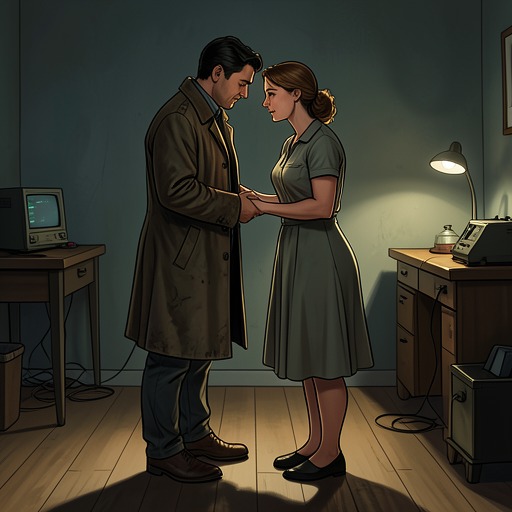
Burning of Nathan Oliver’s galley proofs
The LighthouseThe burning of Nathan Oliver’s galley proofs destroyed the working copies used for his final book and turned an act of apparent destruction into a significant uncertainty in the investigation of his death. The charred paper was found in the grate at his cottage after he had disappeared; both the proofs he edited and Dennis Tremlett’s accompanying copy were missing. The loss mattered not only because it removed an important record of Oliver’s revisions, but because no one could establish from the cottage’s condition who had burned them or when.
The proofs and Oliver’s working method
Oliver preferred to revise at the galley-proof stage rather than on a manuscript. As Tremlett explained to Adam Dalgliesh, Oliver would write changes in pencil on his proofs, and Tremlett would copy them in ink onto his own set. Oliver sometimes continued altering a novel even between printings and would not use a publisher’s editor; he and Tremlett worked through the revisions together. The proofs were therefore not merely spare copies of a finished text. They held the record of a private, collaborative process that Oliver had insisted on controlling.
The two sets kept in the cottage were both missing: Oliver’s marked proofs and Tremlett’s transcription. Tremlett said that the second set of galleys was also important, while Dalgliesh raised the possibility that further copies existed at the publishers. The exchange distinguishes the lost working material from any other possible copies: the evidence establishes that both cottage sets were gone, but does not establish what happened to copies held elsewhere. Their absence meant that the immediate record of Oliver and Tremlett’s corrections could not be consulted in the cottage.
Discovery in the cottage
When Dalgliesh asked about the burned paper in the grate, Miranda Oliver identified it as the proofs of her father’s last book. She said he had been working on them and making important alterations, and insisted that he would not have burned them himself. She believed someone must have entered the cottage during the night. Her response gave the destruction an immediate personal meaning, but her conclusion about an intruder remained an assertion, not an identification of whoever had entered or burned the paper.
The cottage’s ordinary security arrangements made that question difficult to settle. Miranda said the door was very rarely locked because there was no need on the island. Oliver would normally lock it as a matter of habit when he came back late, but might have forgotten or not bothered; it was unlocked when she got up, as she expected it to be after he left. She had heard him return just after eleven the previous night and had seen him leave at twenty past seven that morning. When she came downstairs, he had made tea and eaten a banana. These details establish a narrow sequence around the discovery, but do not show whether the door was entered by an outsider or whether Oliver had left it accessible.
Loss, testimony, and uncertainty
Tremlett initially swallowed and did not answer when Dalgliesh raised the burned paper. Once Miranda left the sitting room, he described the proofs’ importance and explained how the two men had worked. His account made the loss more precise: the destroyed material was part of an established editorial routine, and Tremlett’s copy had gone missing along with Oliver’s. The episode thus shifted the inquiry from the visible remains in the grate to the missing sets and the circumstances in which the cottage had been accessible.
The evidence does not identify the person responsible for the burning. Miranda’s belief that her father would not have destroyed the proofs is clear, but it does not by itself prove that another person entered the cottage. Nor does the existence of charred paper explain whether the proofs were burned to conceal something, to destroy the revisions, or for another reason. The act remains distinct from its interpretation: the paper had been burned, while its agent and purpose were still unresolved in the account of the discovery.
Place in the murder investigation
The proofs were discovered amid the investigation into Oliver’s death, but the medical evidence made clear that the central crime was not a suicide staged by hanging. Edith Glenister estimated that Oliver died between seven-thirty and nine in the morning, probably nearer the earlier time. Her examination established that he died of asphyxiation caused by manual strangulation and that the hanging came later. That finding does not connect the burning to the killing; it places the loss of the proofs beside a death whose apparent form had itself concealed what happened.
The investigation also established a separate appointment concerning Oliver: Raimund Speidel had arranged to meet him at the lighthouse at eight that morning and arrived at six minutes past eight to find its door locked. This provides another strand in the morning’s chronology, not an explanation for the proofs’ destruction. Later, the search of the cottage produced two small packages concealed beneath butter in a tub: a phial labeled with Oliver’s name and date, and a hair sample. Those objects were recovered as evidence, in contrast to the proofs, which had already been reduced to charred paper. The episode’s significance lies in that contrast and in the unanswered question it leaves: the physical traces of the burned text survive, but the working copies—and the identity and purpose of whoever destroyed them—do not emerge from the discovery.